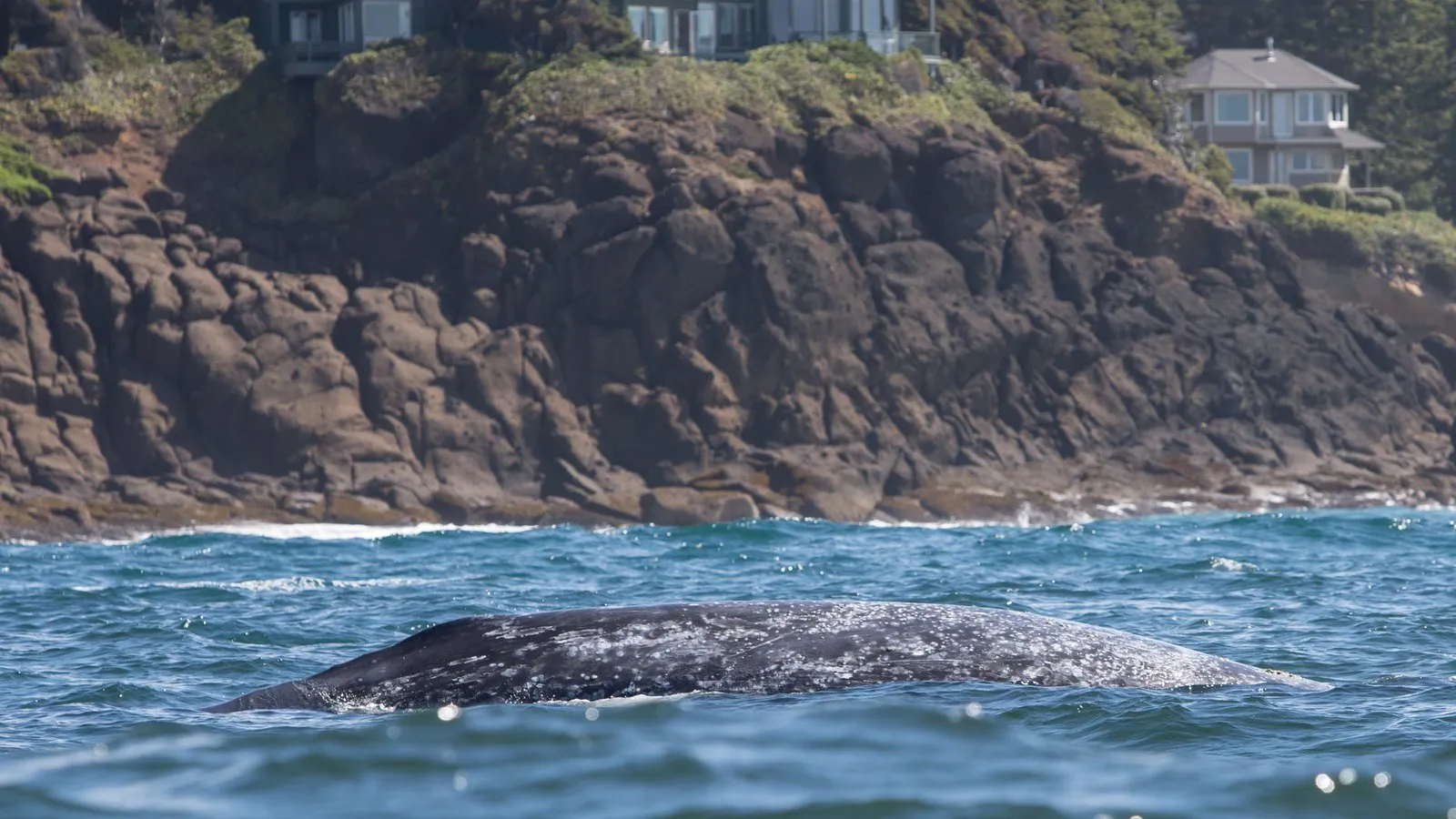
A gray whale surfaces off Depoe Bay, where about 200 resident gray whales feed close to shore in summer and fall. Photo: Nicki Dugan Pogue from San Francisco, USA / Wikimedia Commons, CC BY-SA 2.0
Three conservation groups have gone to federal court to force a decision on whether the gray whales that migrate past the Oregon coast every winter should return to the endangered species list, more than 30 years after they came off it.
Oasis Earth, the Center for Biological Diversity and the International Marine Mammal Project of Earth Island Institute filed the complaint Nov. 17 in U.S. District Court for the Northern District of California (Case No. 3:26-cv-13925). They are suing the National Marine Fisheries Service, part of NOAA, for missing the deadline to respond to a listing petition.
What the lawsuit asks for
The case is narrower than the headlines around it. It does not ask a judge to list the whales. It asks the court to declare that the agency broke the Endangered Species Act by not issuing a “90-day finding,” the first step that says whether a petition presents enough information that listing may be warranted, and to order the agency to publish one.
According to the complaint, the agency received the petition, written by Oasis Earth founder Rick Steiner, on Aug. 24, 2025. That made the 90-day finding due Nov. 22, 2025, and a full 12-month finding due by Aug. 24, 2026. The complaint says Steiner asked for updates in February and April. In February, the agency wrote back that it was working on the finding and “hope[d] to dedicate more time to th[e] petition in the upcoming month(s).” NOAA’s own list of petitions awaiting 90-day findings still includes it.
The complaint notes Steiner’s Oregon ties: he worked on research off the Oregon coast for Oregon State University in the 1970s and fished commercially off Oregon for Dungeness crab, halibut and albacore.
A NOAA spokesman, Michael Milstein of Portland, declined to comment on the lawsuit, citing pending litigation, and said the petition “remains under consideration,” the Alaska Beacon reported in a story republished by the Lincoln Chronicle.
The numbers on each side
The groups’ case rests on deaths and births. The complaint says NOAA has recorded 192 gray whale deaths along the West Coast between Alaska and Mexico in 2026, including 31 in Washington and 27 in Alaska, and argues the real number is higher because most carcasses sink. It cites at least 14 deaths this year from blunt-force trauma consistent with ship strikes. In 2025, it says, only 85 calves were counted, the lowest since recording began.
Those deaths follow an unusual mortality event that NOAA says ran from December 2018 to November 2023 and involved 690 strandings: 347 in the United States, 316 in Mexico and 27 in Canada. NOAA’s investigators tied it to changes in the whales’ Subarctic and Arctic feeding areas that led to malnutrition, fewer births and more deaths.
NOAA’s most recent count is more mixed. A Southwest Fisheries Science Center report posted in July estimated 17,750 eastern North Pacific gray whales during the 2025-26 southbound migration, with a range of 15,930 to 20,530. That is well below the roughly 26,960 the complaint cites for 2015-16, but above the 11,700 to 14,200 it cites for 2024-25. The NOAA authors wrote that the apparent increases “suggest that the population’s status may have improved,” but that year-to-year inconsistencies and low calf production since 2019 call for more research.
The eastern population was delisted in 1994 after recovering from whaling, according to NOAA’s species profile. The western population off Russia, estimated at fewer than 300 animals, remains endangered.
Gray whales on the Oregon coast
Gray whales are part of daily life on this coast. Oregon State Parks says thousands of them pass from mid-December through mid-January on the way to Baja California, and about 200 resident whales stay through summer and fall, with the central coast a hot spot from June to mid-November. Volunteers staff 15 viewing sites during Whale Watch Weeks in late December and late March, and the state’s Whale Watching Center in Depoe Bay is open year-round.
The whales also support local businesses, from the Depoe Bay charters to visitors at Yaquina Head. Entanglement in fishing gear is one of the threats the petition lists, an issue the crab fleet already deals with for humpbacks. A listing, if it ever came, would add federal protections under the Endangered Species Act on top of those the whales already have under the Marine Mammal Protection Act.
That is still several steps away. Even if the court orders a 90-day finding, a positive one would only open a status review, and a negative one would end this petition. For now, the next count that matters will come from the shore this winter, when the southbound migration passes Oregon again.
Rosalind Teague covers ocean science, coastal hazards and the people who shaped the central coast.