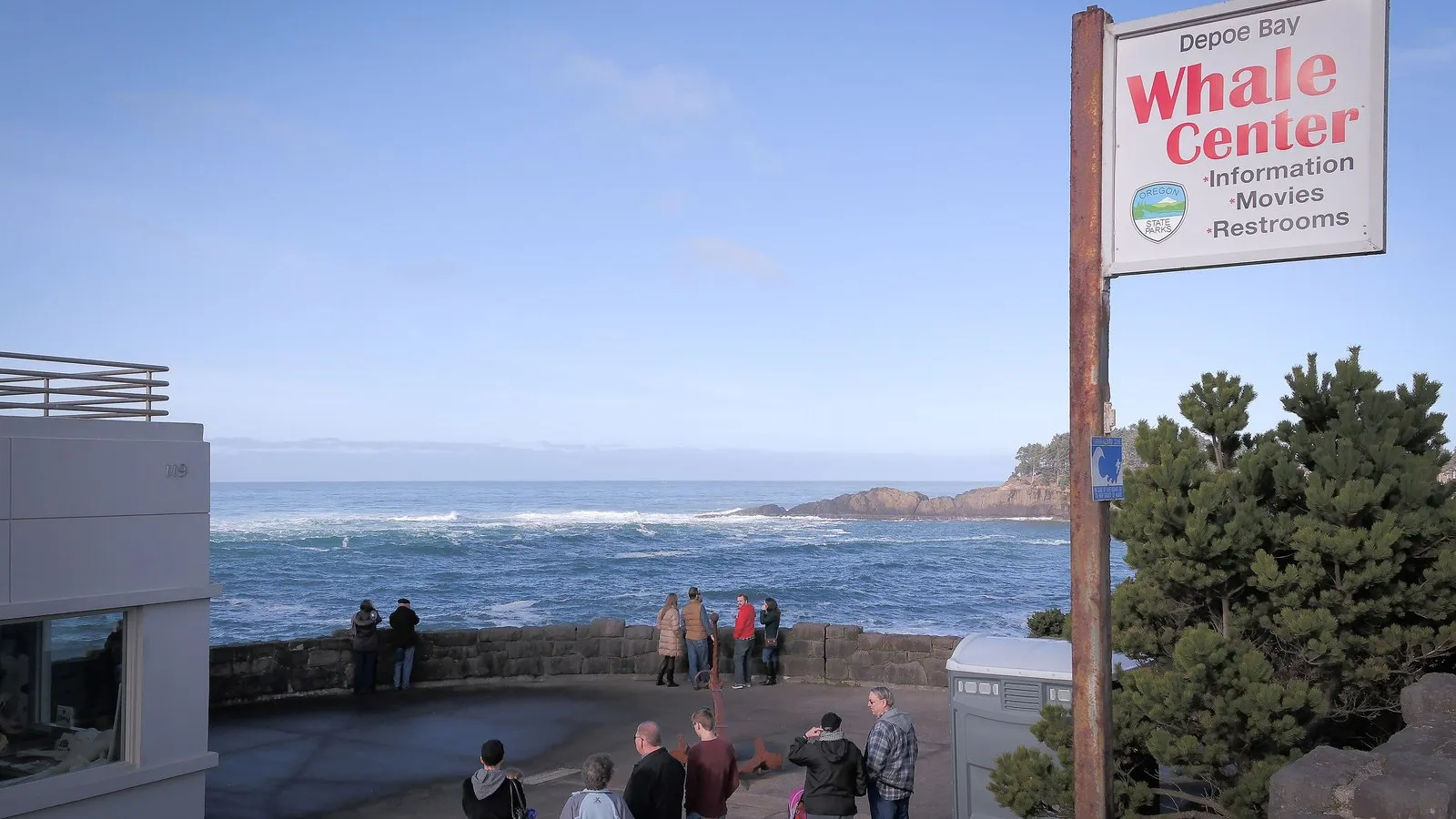
Whale watchers on the seawall at the Whale Watching Center in Depoe Bay. Photo: Visitor7 / Wikimedia Commons, CC BY-SA 3.0
Oregon State Parks’ Winter Whale Watch Week returns Dec. 27-31, when volunteers will set up at viewpoints along the coast to help visitors spot gray whales heading south toward Mexico. Anyone who wants to be one of those volunteers has until Tuesday, Dec. 1, to register.
This year’s migration also arrives with an unusual question attached. Federal scientists counted far more gray whales on last winter’s southbound trip than the year before, and they aren’t sure the increase is real.
The week and the volunteers
The Oregon Whale Watch program, run by Oregon Parks and Recreation, lists Winter Whale Watch 2026 for Dec. 27-31 and Spring Whale Watch 2027 for March 20-28. Volunteers staff their sites from 10 a.m. to 1 p.m., count whales and visitors, and file a daily tally. Most sites have two to eight volunteers on a given day, and volunteers are asked to commit to at least two days per week.
The program’s volunteer page says registration for both the winter and spring weeks runs from Oct. 7 to Dec. 1, through a new platform called Get Connected. Spring registration reopens Jan. 1 and runs through March 1. New volunteers must attend a training or watch a recorded one before they work a site.
For visitors, the program’s hub is the Whale Watching Center on the seawall in Depoe Bay, at 119 S. Highway 101, which lists its current hours as 10 a.m. to 4 p.m., Wednesday through Sunday. The program has roots in Newport. In 1978, Don Giles of Hatfield Marine Science Center started what became Whale Watching Spoken Here after colleagues Bruce Mate and Denise Herzing confirmed that gray whale migrations past Yaquina Head peak at two times of year: the winter holidays heading south, and late March heading north. We wrote about the volunteers who keep that program going earlier this year.
At the peak of the southbound migration, the program says, about 30 whales an hour pass the Oregon coast. Northbound, the rate is closer to six an hour, spread over four months.
A count that surprised the counters
In July, NOAA Fisheries’ Southwest Fisheries Science Center released a new population estimate based on whales counted on their 2025-26 southbound migration. It put the Eastern North Pacific gray whale population at about 17,750, with a range of 15,930 to 20,530. The year before, the estimate was about 12,890, one of the lowest since counting began in the late 1960s.
That would be good news, except that NOAA’s own researchers say the jump likely exceeds what the population could produce. Scientists estimated just 85 calves in 2025, the lowest on record. NOAA says the apparent increase may instead reflect changes in survey conditions or in whale behavior, such as migration timing, that affect what share of the population passes the counting station.
“We know that we don’t see every whale,” said Aimee Lang, a research scientist who helps lead the counts. “One of the questions raised by our most recent count is whether we see a consistent proportion of the population every year, or whether other factors affect how much of the population we see and count.”
The broader trend is not encouraging. Gray whales peaked at about 27,000 around 2015-16, then declined. NOAA declared an unusual mortality event from 2019 to 2023 after a spike in strandings, and says strandings in the last two years have climbed back into that range, with many stranded whales thin or emaciated. Researchers are now using drones at their central California station to check how accurately counters estimate group sizes.
The status question is also in court. As we reported earlier this month, conservation groups sued to force a federal decision on listing gray whales as endangered.
Where to watch
About 200 gray whales skip the full migration and feed along the Oregon coast through the summer, according to the program, so local watchers see whales most of the year. But late December is when the most pass. Yaquina Head, covered in our local guide to the headland, is one of the classic viewpoints, and Depoe Bay’s seawall puts watchers close to the water. Look for the spout first, then the long, mottled back.
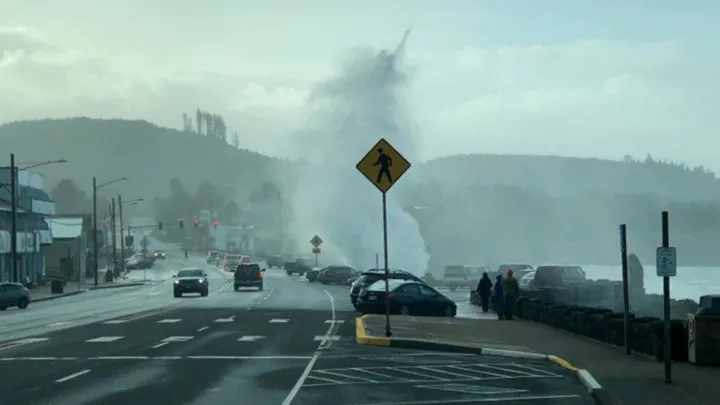
The state’s beach safety advice still applies on stormy December days: stay out of fenced areas, know the tide schedule and keep an eye on the surf. More ocean coverage is on our Ocean & Science page.
Rosalind Teague covers ocean science, coastal hazards and the people who shaped the central coast.