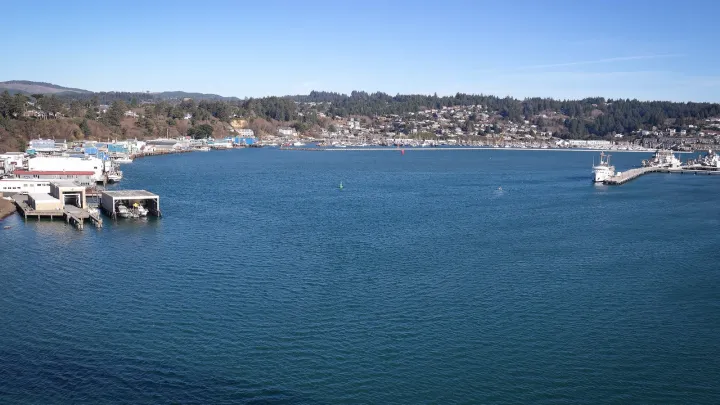
In a seawater lab on the south side of Yaquina Bay, Oregon State University researchers have spent decades breeding Pacific oysters to grow fast, resist disease and, more recently, hold up better in acidic ocean water.
The work is run through OSU’s Molluscan Broodstock Program at the Hatfield Marine Science Center in Newport. Professor Chris Langdon has been breeding oysters there since 1996, according to OSU’s College of Agricultural Sciences. The lab’s flowing seawater system pipes water from the bay into dozens of tanks, as OSU’s Terra magazine described it.
For the coast’s shellfish growers, the stakes are practical. A 2017 review in the journal ACS Central Science describes the program as breeding stock for the $250 million West Coast oyster industry.
The 2007 die-off that changed the research
The turning point came in 2007, when oyster larvae died in huge numbers at the Whiskey Creek hatchery on Netarts Bay. Researchers first suspected bacteria, but further work pointed to increasingly acidic ocean water, Terra reported. When carbon dioxide dissolves in seawater, it lowers the pH and leaves less of the carbonate that young oysters need to build shells.
OSU oceanographer Burke Hales developed an automated monitoring system, nicknamed the “Burkolater,” that many West Coast hatcheries now use to track and adjust their water, according to Terra. The ACS Central Science review says a federally sponsored network of monitoring systems went into West Coast hatcheries in 2010, and that buffering the water has since helped them avoid major larval die-offs.
What the breeding has shown
Langdon’s team found that its selected oyster lines outperformed wild stocks in both acidified and normal water. “We get about 30 to 40% higher settlement with larvae from MBP stocks compared to wild stocks (under acidification) and about 50% higher set under ambient conditions,” Langdon told Terra. Settlement, when larvae attach to a surface, is the step young oysters must survive to become adults.
Graduate student Evan Durland, working in Langdon’s lab, found that acidification hits hardest at the larval stage and affects hundreds of genes, including some tied to the calcium transport needed for shell building, OSU reported. His work also suggested that early harm can be reversible as the larvae develop.
Turning that into a reliably resilient oyster will take time. “Selecting stocks based on hundreds of markers is very difficult,” Langdon said in the OSU account. The same research turned up some good news for a native species: the Olympia oyster, which broods its young before releasing them, proved much more resistant to acidification than the Pacific oyster.
Hatfield’s research shows up often in our ocean science coverage, including the Newport hydrographic line that tracks low-oxygen water and the story of the senator the center is named for.
The program’s selected lines continue to supply West Coast hatcheries. Growers and readers can follow its work through the Newport Aquaculture Laboratory and OSU’s Hatfield Marine Science Center.
Rosalind Teague covers ocean science, coastal hazards and the people who shaped the central coast.