Photo: Lynn Ketchum, Oregon State University / Wikimedia Commons, CC BY-SA 2.0
Drive U.S. 101 through Lincoln County and you cross the work of one engineer again and again. Conde B. McCullough led Oregon’s bridge program in the 1920s and 1930s, and his designs, with their arches, Gothic-style railings and art deco pylons, still define the look of the coast highway.
From Iowa to Oregon
McCullough was born in 1887 and studied civil engineering at Iowa State. He came to Oregon in 1916 to teach at Oregon Agricultural College, now Oregon State University, in Corvallis, and in 1919 became the state highway department’s bridge engineer. Over the next decade and a half his office designed hundreds of bridges across Oregon. He later earned a law degree and wrote on engineering and bridge law.
Bridges as public places
McCullough believed bridges should be both economical and handsome, and that a public structure in a beautiful place owed something to its setting. He favored reinforced concrete arches, which suited Oregon’s materials and climate, and used steel where long spans demanded it. Along the coast, he added the observation alcoves, stairways and decorative detail that make many of the bridges places to stop rather than just cross.
The 1920s arches
Before the big bay crossings, McCullough’s office designed smaller bridges as the coast highway was built through Lincoln County in the 1920s. Two of the best known are close together south of Depoe Bay. The Depoe Bay Bridge, finished in 1927, spans the narrow channel into what is often called the world’s smallest harbor. The Rocky Creek Bridge, also from 1927, is a concrete deck arch on today’s Otter Crest Loop. It was later named for Ben Jones, the legislator who pushed for the coast highway, as we explain in our story on Jones.
The 1936 bridges
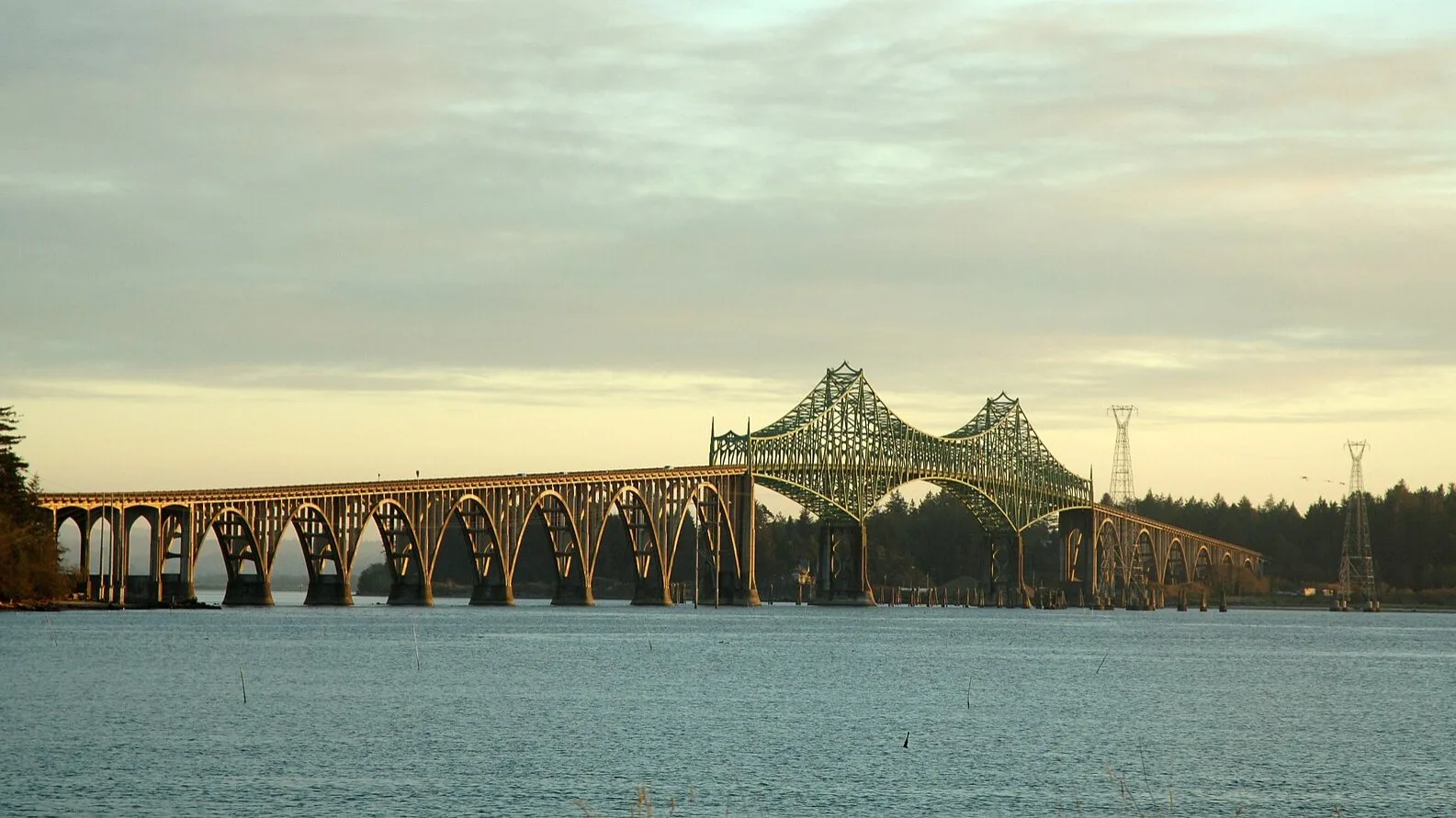
The coast highway’s last gaps were river and bay mouths crossed by ferries. With federal Public Works Administration money during the Depression, McCullough’s office designed five major bridges that opened in 1936: across Yaquina Bay at Newport, the Alsea at Waldport, the Siuslaw at Florence, the Umpqua at Reedsport and Coos Bay at North Bend.
The Yaquina Bay Bridge, opened Sept. 6, 1936, is about 3,200 feet long. Its centerpiece is a 600-foot steel arch over the shipping channel, flanked by concrete arches and approach spans. Its pylons and stairways reflect the art deco style of the time.
The Alsea Bay Bridge in Waldport was not so lucky. Salt corrosion damaged it badly, and it was replaced in 1991. Pieces of the old bridge are displayed at the Alsea Bay Bridge Interpretive Center in Waldport, which has exhibits on the coast bridges. For a look at the area, see our guide to crabbing Alsea Bay.
His legacy
McCullough later worked on highway projects in Central America and served as an assistant state highway engineer. He died in 1946, and the following year the Coos Bay bridge was renamed in his honor.
In 2005, many of his coast bridges were listed on the National Register of Historic Places, and the coast highway was later named an All-American Road. ODOT has spent decades protecting the concrete from salt air, a challenge McCullough knew about but could not solve with the materials of his day.
Seeing the bridges
In Lincoln County, the easiest places to see his work are the Yaquina Bay Bridge, viewable from the Bayfront and from Yaquina Bay State Recreation Site, the Depoe Bay Bridge from the seawall downtown, and the Rocky Creek Bridge from the overlook on Otter Crest Loop. Read about the upkeep of the Yaquina Bay Bridge.
Dewey Albrecht covers the Port of Newport, commercial and sport fishing and the Yaquina Bay bar.