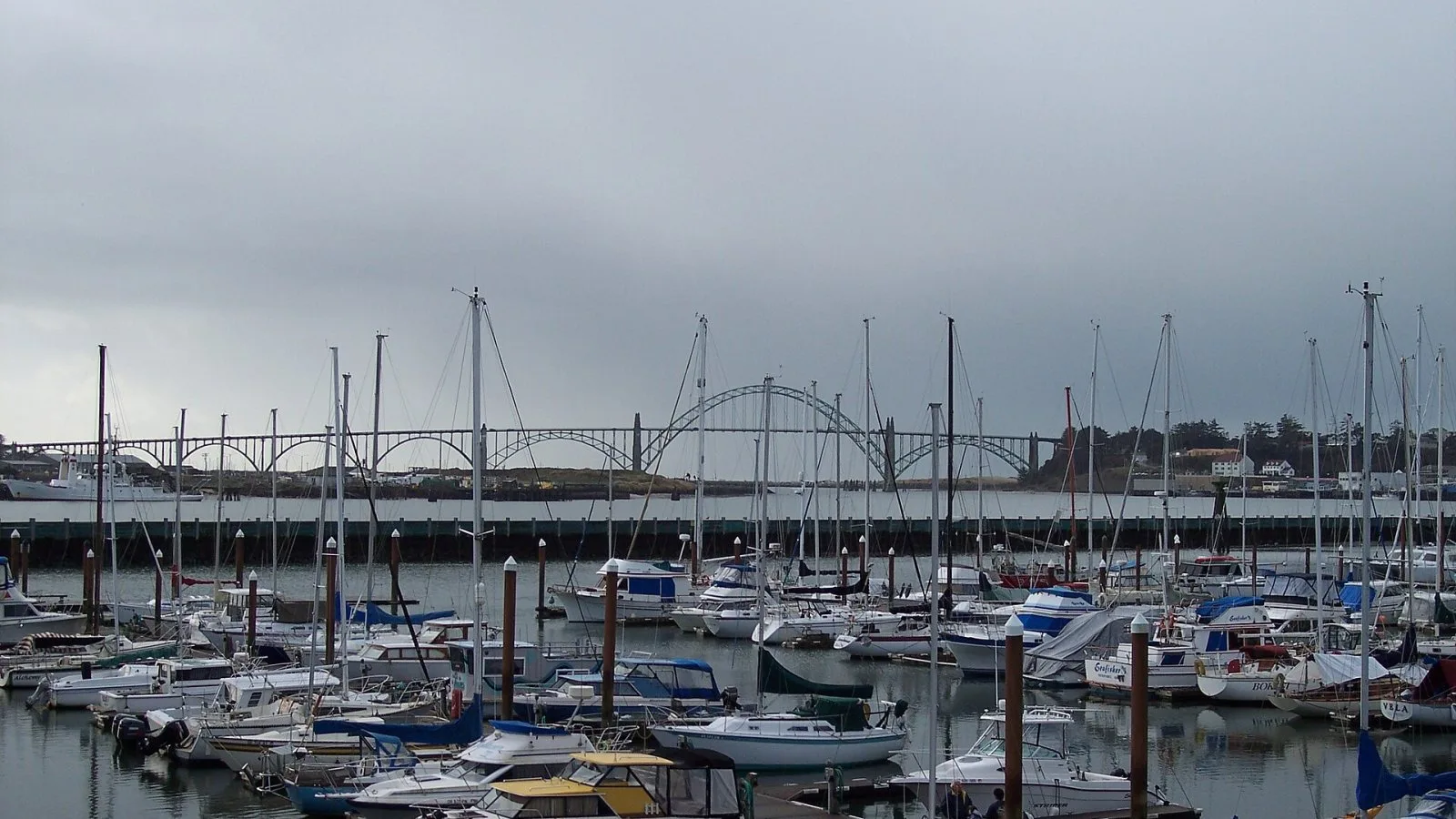
Photo: Visitor7 / Wikimedia Commons, CC BY-SA 3.0
The Yaquina Bay Bridge carries U.S. 101 over the mouth of Yaquina Bay and is the outline most people picture when they think of Newport. It opened on Sept. 6, 1936, one of the last links in the Oregon Coast Highway, and it is listed on the National Register of Historic Places. Keeping it in service in salt air is a long-running project for the Oregon Department of Transportation.
Salt, rain and steel
The bridge, about 3,200 feet long, combines a 600-foot steel arch over the shipping channel with concrete arches and approach spans on both sides. Salt spray gets into concrete and reaches the reinforcing steel inside, which rusts and expands, cracking the concrete from within. Coastal bridges in Oregon need regular inspection, patching and painting just to hold their condition.
A protective current
ODOT has used cathodic protection on its historic coast bridges, including the Yaquina Bay span. Crews remove damaged concrete, repair the steel and apply a thin coating of zinc that is connected to the reinforcing bars. The zinc corrodes in place of the steel, slowing the damage. The work is done in sections under containment, which is why scaffolding and wraps can stay on parts of the bridge for long stretches.
The Yaquina Bay Bridge first received a zinc system decades ago, and the zinc wears away over time. In spring 2020, ODOT began a major restoration with three goals: protecting the bridge from corrosion, repairing damaged concrete and strengthening it against earthquakes.
According to Vector Corrosion Technologies, which worked on the project, crews replaced about 320,000 square feet of thermally sprayed zinc on the concrete. ODOT announced in November 2023 that the project was finished about six months ahead of schedule and $2 million under budget, which the agency said reduced management and overhead costs.
Next: the steel arch
The concrete work did not cover the steel arch. ODOT’s draft 2027-2030 transportation improvement program includes a separate project to repaint the arch, tentatively planned for 2029 to 2031. Crews would sandblast the old coating, repair or replace damaged steel and repaint it in the bridge’s traditional green.
Traffic and detours
Because there is no other crossing near the bay mouth, most work is scheduled to keep traffic moving, often with lane restrictions, flaggers or night work. Pedestrians and cyclists sometimes face sidewalk closures. ODOT posts project notices and lane closures on TripCheck, its traveler information site, which is the most current source before a trip across.
The bridge carries all through traffic on U.S. 101 in Newport, plus local trips between the Bayfront and South Beach, home to the Oregon Coast Aquarium, Hatfield Marine Science Center and NOAA’s Marine Operations Center. Without it, the detour inland is long.
Earthquake questions
Like most bridges of its era, the Yaquina Bay Bridge was not designed for a magnitude 9 Cascadia earthquake. The 2020-23 project added some seismic upgrades, but ODOT has not said the bridge would survive the largest earthquake. Its long-range plans for seismic upgrades on U.S. 101 include coastal crossings, though work on the coast competes with other priorities statewide.
For residents, that means planning for a Cascadia earthquake without counting on the bridge. People south of the bay should know their route to high ground in South Beach, as shown on the tsunami evacuation maps. For the engineer who designed it, read our profile of Conde McCullough.