Photo: Visitor7 / Wikimedia Commons, CC BY-SA 3.0
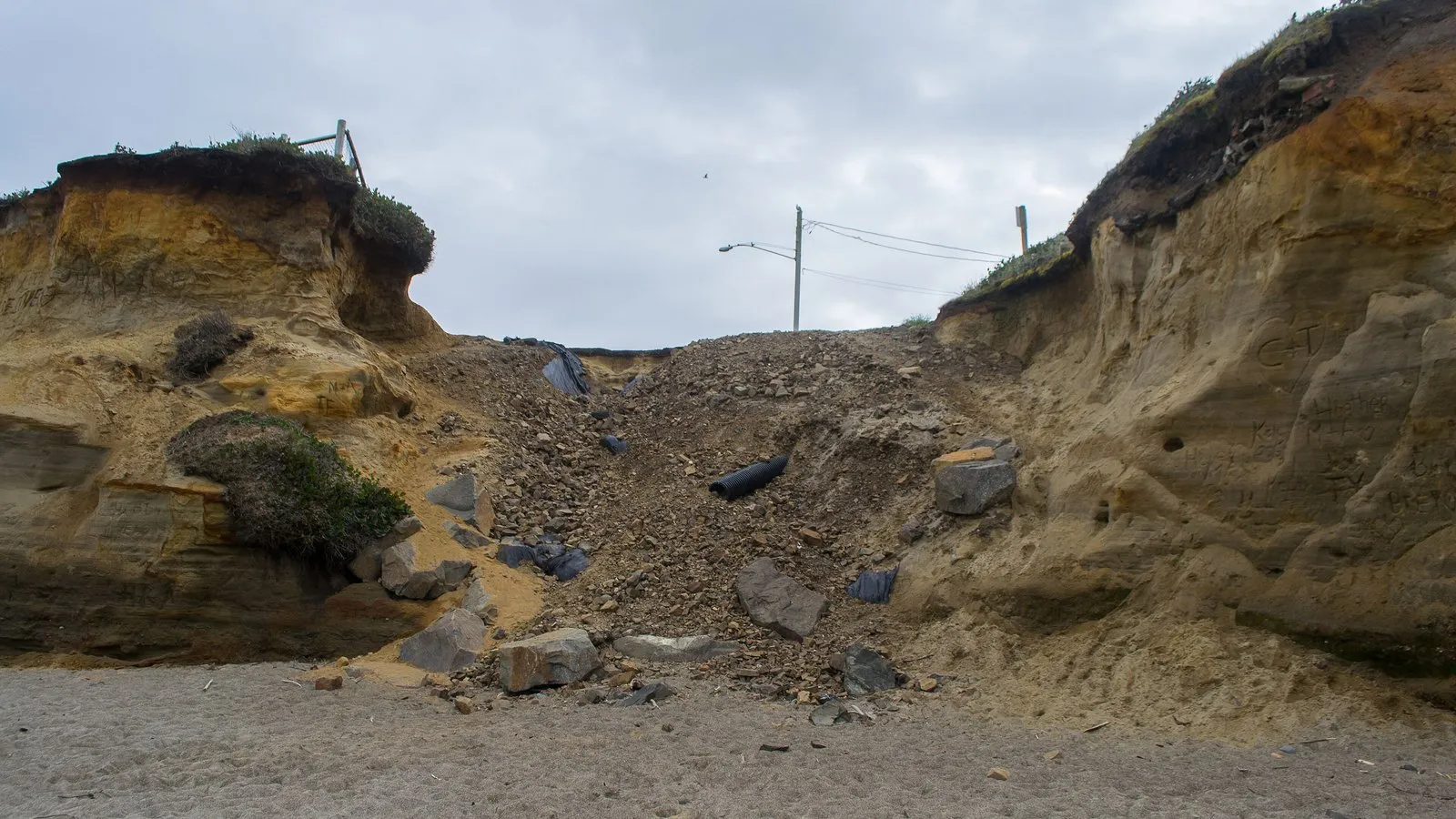
Oregon earned one of the three best grades in the Surfrider Foundation’s 2026 State of the Beach report, but the two places the report holds up as warnings are both in Lincoln County. Surfrider says Oregon “has already lost walkable beaches along the Salishan Spit and Gleneden Beach to emergency riprap.”
This year’s report looks at one narrow piece of coastal law: what happens when a storm or erosion event puts a house or road in danger and the owner gets permission to pile rock, sandbags or concrete on the beach as a short-term fix. Surfrider graded 30 coastal and Great Lakes states on seven criteria, including how narrowly each state defines an emergency, whether it requires written approval before work starts, whether the structures have to be temporary and come out, and whether it has clear enforcement rules.
Connecticut, Oregon and Texas got a B. No state got an A. Twenty-seven states got a C or lower, and five got an F.
What the report found in Oregon
The Oregon numbers come from the report’s regional case study. Of the 29 emergency armoring permits issued in the state over the past decade, 20 came during a single erosion event in 2021, according to Surfrider. In every Oregon case the group analyzed, it says, the “temporary” armoring became a bridge to a permanent hard structure.
The national report calls that pattern an “Emergency to Permanent Permit Pipeline.” Once rock is in place, the report says, the beach in front of it is pinned in place, sand that would feed it from the bluff is cut off, and erosion speeds up on neighboring lots, which then need their own armoring.
Surfrider’s Oregon chapter, in a post on the results, tied the timing to the coming winter. “With another El Niño winter approaching, these findings are especially timely,” the chapter wrote, noting that El Niño conditions can bring higher water levels, bigger waves and more erosion. The group’s priorities for Oregon are stronger requirements for emergency permits, clear deadlines and accountability for removing temporary structures, and nature-based or non-structural options where they will work.
The grades measure what is written into law, not how well it is enforced, and the report says strong rules can still fail without follow-through.
How Oregon’s emergency permits work
Rock on the beach is regulated by the Oregon Parks and Recreation Department, which manages the ocean shore as a state recreation area. State law bars improvements on the ocean shore without a permit, and OPRD handles them through its ocean shore alteration permit program, which covers beach accesses, dune grading and shoreline protection such as riprap and seawalls.
The emergency version is meant for an upland building or other infrastructure “in imminent peril of being destroyed or damaged by action of the Pacific Ocean,” according to OPRD’s emergency permit page. Owners call a hotline, OPRD checks whether the property and project are eligible, and a written application has to be in before the agency gives written approval. The application includes drawings and a land use compatibility statement from the city or county.
Under the state rule OPRD quotes, OAR 736-020-0070, material placed under an emergency authorization “shall be considered temporary and shall be removed within a time specified by the Department.” To keep it longer or replace it with something permanent, the owner has to get a regular ocean shore alteration permit before the removal date. If that doesn’t happen, OPRD says the owner can lose part or all of a bond and face civil penalties and an order to take the material out, with removal and beach restoration at the owner’s expense.
Shoreline protection on the Oregon coast is also limited by Statewide Planning Goal 18, which generally restricts new beachfront protective structures to development that existed on Jan. 1, 1977. OPRD’s permit pages point owners to the local planning office for that eligibility call.
What’s next
The rules are in the middle of a rewrite. OPRD says its ocean shore permitting rules have not been updated in more than 25 years, and it convened a rule advisory committee in December 2025 to work through application requirements, emergency and general authorizations, enforcement and fees, along with changes required by House Bill 2925 from the 2025 session. Surfrider says it has a seat on the committee.
The schedule has slipped. OPRD first planned public comment in spring 2026 and adoption by the State Parks and Recreation Commission in fall 2026. An extension notice pushed the committee’s meetings through July, with comment in fall 2026 and adoption in spring 2027. The agency’s rulemaking page now lists the meetings after February as cancelled and says public comment on the proposed rules is “upcoming,” with no date posted.
That means this winter’s storms will be handled under the existing rules. Owners on eroding lots can find OPRD’s hotline and application steps on its emergency permit page. Comments on the draft rules will be taken once OPRD opens the comment period.
OPB’s “Think Out Loud” talked with Surfrider’s Oregon Beaches Forever fellow, Taylor Wood, about the report on Nov. 17.
For more on the ocean and the science behind the coast’s changes, see our Ocean & Science coverage, including how Newport’s hydrographic line tracks hypoxia off the coast and the domoic acid behind this fall’s razor clam closure.