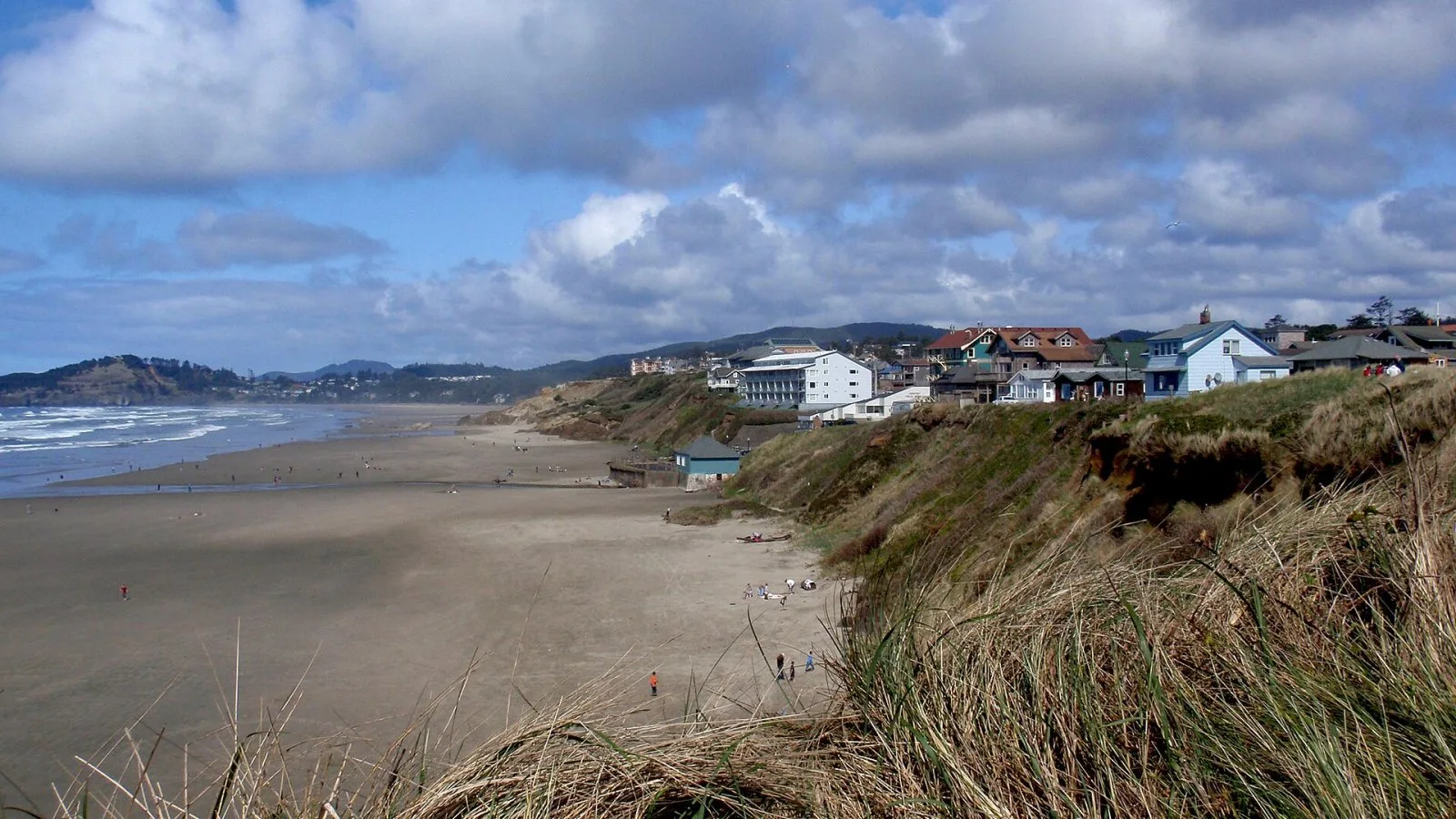
Photo: Hrare / Wikimedia Commons, CC BY-SA 3.0
On the Oregon coast, you can walk the sand in front of a resort, a vacation rental or a private home without asking anyone’s permission. That right is unusual in the United States, and it rests on two moments in state history more than 50 years apart.
A beach as a highway
In the early 1900s, the beach was the main road along much of the Oregon coast. Wagons, mail carriers and early cars traveled on the hard wet sand at low tide because there was no road inland. In 1913, Gov. Oswald West persuaded the Legislature to declare the wet-sand shore from the Columbia River to California a public highway. West later said his real aim was to keep the beaches from being sold off. The law protected the land below the ordinary high tide line, but it did not cover the dry sand above it.
The 1966 motel fight
That gap mattered in the 1960s. In 1966, William Hay, owner of the Surfsand Motel in Cannon Beach fenced off part of the dry sand in front of the motel for its guests. Other beachgoers objected. The Legislature took up the issue in 1967, as worries grew that other property owners would do the same.
The bill that followed, House Bill 1601, became known as the Beach Bill. It faced strong opposition from some property owners and developers. Gov. Tom McCall pushed hard for it, including a well-publicized visit to the beach with surveyors to show where the public’s line should be. The Legislature passed the bill, and McCall signed it on July 6, 1967.
What the law says
The Beach Bill recognized public rights to the dry-sand beach up to the line of vegetation or a surveyed 16-foot elevation line, whichever is farther inland. It declared that the public had used the beach for generations and that those rights should be protected. Property owners still own the land, but the public has the right to use it for recreation. The Oregon Parks and Recreation Department manages the ocean shore as a state recreation area.
The law was quickly challenged in court. In State ex rel. Thornton v. Hay, decided in 1969, the Oregon Supreme Court upheld the public’s right to use the dry sand. The court relied on the legal doctrine of “custom.” It found that the public had used Oregon’s beaches since before statehood, so that use had become a right. The case involved the same Cannon Beach motel owners.
What it means today
Because of these laws, almost all of Oregon’s 363-mile coastline is open to the public, including the beaches in front of Lincoln County’s resorts and vacation homes. Anyone can walk, picnic, fly a kite or look for glass floats on any beach. Our stories on Lincoln City’s Finders Keepers program and the D River kite festivals describe two popular beach activities.
The right of access to the sand does not mean a right to cross private land to reach it. Beachgoers should use public access points, which are marked along U.S. 101 and in coastal towns. State parks and city waysides provide parking and paths. Rules also apply on the beach itself, such as limits on driving, fires, camping and harming wildlife, and closures to protect nesting western snowy plovers in some areas.
Coastal erosion and sea level rise are raising new questions. Shoreline armoring like riprap can affect public beaches, and state rules limit where it is allowed. The state has also dealt with issues such as how far inland the public’s rights extend when the vegetation line moves.
Oregonians still treat the Beach Bill as a point of pride. In 2017, the state marked its 50th anniversary. The idea behind it goes back to West’s 1913 law: the beach belongs to everyone. For more on how the coast road shaped that history, see our story on Ben Jones and the coast highway.