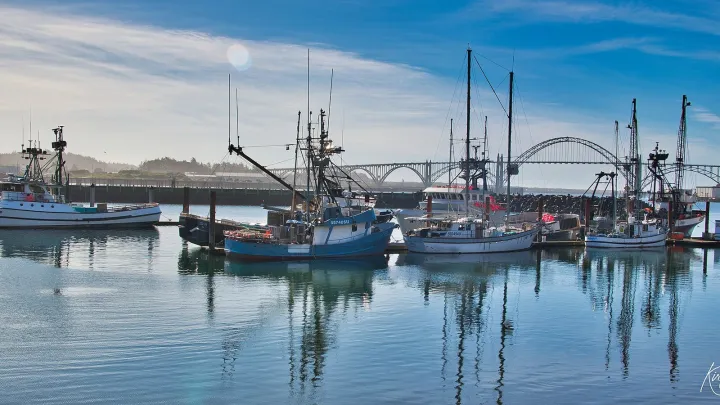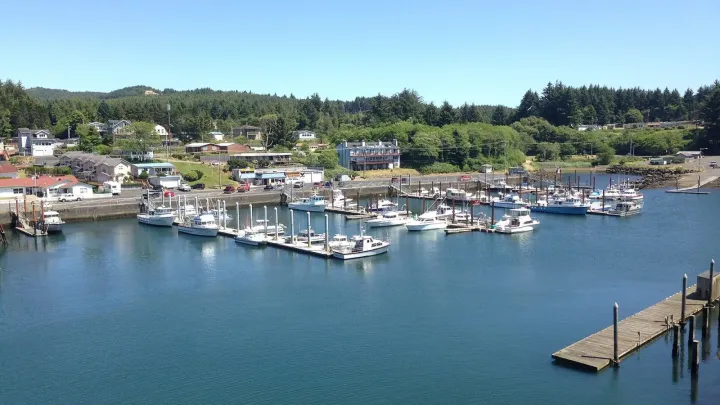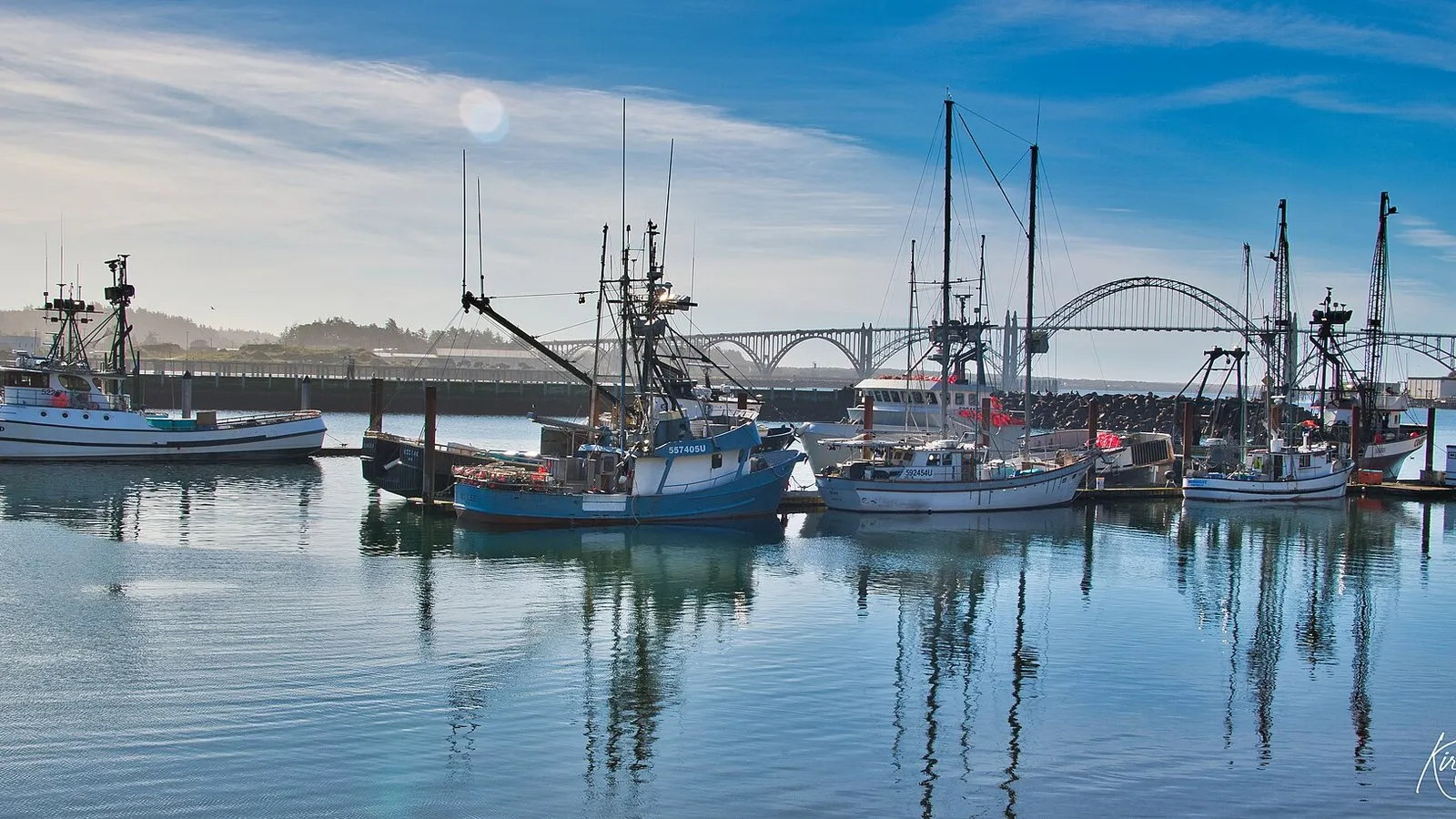
Commercial fishing boats on Yaquina Bay in Newport, with the Yaquina Bay Bridge behind. Photo: Kirt Edblom, CC BY-SA 2.0, via Wikimedia Commons.
Ten days after fire tore through Pacific Seafood’s cold-storage building on Newport’s Bayfront, the waterfront looks mostly normal again. Tourists are back on Bay Boulevard, crews are rigging crab pots at the Port of Newport, and the sea lions are as loud as ever. What’s left of the 11,000-square-foot building is still a heap of blackened metal and wood spilling toward the street, and the questions it raised about the harbor’s reliance on a single big processor haven’t gone away.
The fire
The fire broke out on the morning of Sunday, Oct. 25, at the company’s cold-storage building on SW Bay Boulevard. Because the building housed two large ammonia tanks, officials ordered every business on the Bayfront closed and evacuated homes on the hills above and up to a mile out. Crews poured roughly 1.6 million gallons of water on the site. The ammonia tank held, according to the state fire marshal’s office, and no workers were hurt. One firefighter was treated for exhaustion.
It was the largest fire Newport has seen in a decade. A video posted on social media showed equipment on the plant’s exterior exploding shortly before flames took hold. Central Lincoln People’s Utility District later said the equipment wasn’t its transformers. The Oregon State Fire Marshal’s office is leading the investigation and hasn’t named a cause.
Lincoln County property records valued the building at $2.6 million. The company hasn’t said how much product was inside. “The facility that was affected was a cold storage facility and we are still working to understand the extent of the loss,” Eric Mills, a lawyer for Pacific Seafood, told the Lincoln Chronicle.
Back to work, mostly
By Monday, workers were back in the company’s other buildings along the Bayfront. A spokesperson told the Chronicle that Pacific Seafood had kept its full Newport team at full hours and hadn’t turned away a single vessel. The stretch of Bay Boulevard closest to the ruined building remains closed while cleanup continues.
Port of Newport executive director Paula Miranda offered the company the former Rogue Brewing building in South Beach for storage. The problem, she said, is that Pacific Seafood needs freezer space, not just cooling space, so it will likely rely on freezer trucks and capacity it has elsewhere. Local officials, legislators and the Newport Fisherman’s Wives held an online meeting soon after the fire to look for temporary sites. Company executives were invited and didn’t take part.
One big buyer left
The timing could have been worse. The fire came between the end of shrimp season and the opening of commercial Dungeness crab in mid-December. Taunette Dixon, who sells groundfish and crab to Pacific Seafood from her boat, the Tauny Ann, and is co-president of the Newport Fisherman’s Wives, said the lost cold storage could make it harder for crabbers to buy bait locally this winter. Some may have to go elsewhere.
“We are one of the last working bayfronts on the coast,” Dixon said. “Right now we are on standby, waiting to hear how we can help.”
Her concern goes beyond bait. When Bornstein Seafoods closed its Newport operations in 2024, Pacific Seafood became the only large industrial processor left in town. Newport had four fish plants in the 1980s. Today, a large share of the port’s roughly 250 commercial vessels depend on one company to offload and process their catch, according to Sarah Buddingh, a research economist with the Lincoln County Economic Development Alliance. She puts commercial fishing at about 12 percent of county employment and $354 million a year in economic activity.
Pacific Seafood reported 227 employees in Lincoln County this year, typically enough to rank it among the county’s ten largest employers. The Newport plants mainly handle shrimp, along with smaller amounts of salmon, cod and flounder. Whiting processing moved to the company’s Astoria and Warrenton operations years ago.
The company, founded as a Portland retail fish business in 1941, now runs more than 40 facilities nationwide. It has spent more than a decade fending off lawsuits from fishing groups accusing it of monopoly power. Those suits were dismissed. It’s also contesting $3.2 million in Oregon Department of Environmental Quality fines over water-quality violations at plants in Charleston, Brookings and Warrenton.
What to watch
There’s precedent for rebuilding. A Pacific Seafood plant in Warrenton burned in 2013 and was replaced in 2018 with a 78,000-square-foot facility that included two stories of cold storage. Whether the company rebuilds on Bay Boulevard, and how quickly, is the question the fleet will be asking as crab season gets close. The fire marshal’s findings on what started the blaze are still to come.
Silas Kerrigan covers business, the tourism economy and household finance in Lincoln County.