Photo: Gary Halvorson, Oregon State Archives / Wikimedia Commons, CC BY 4.0
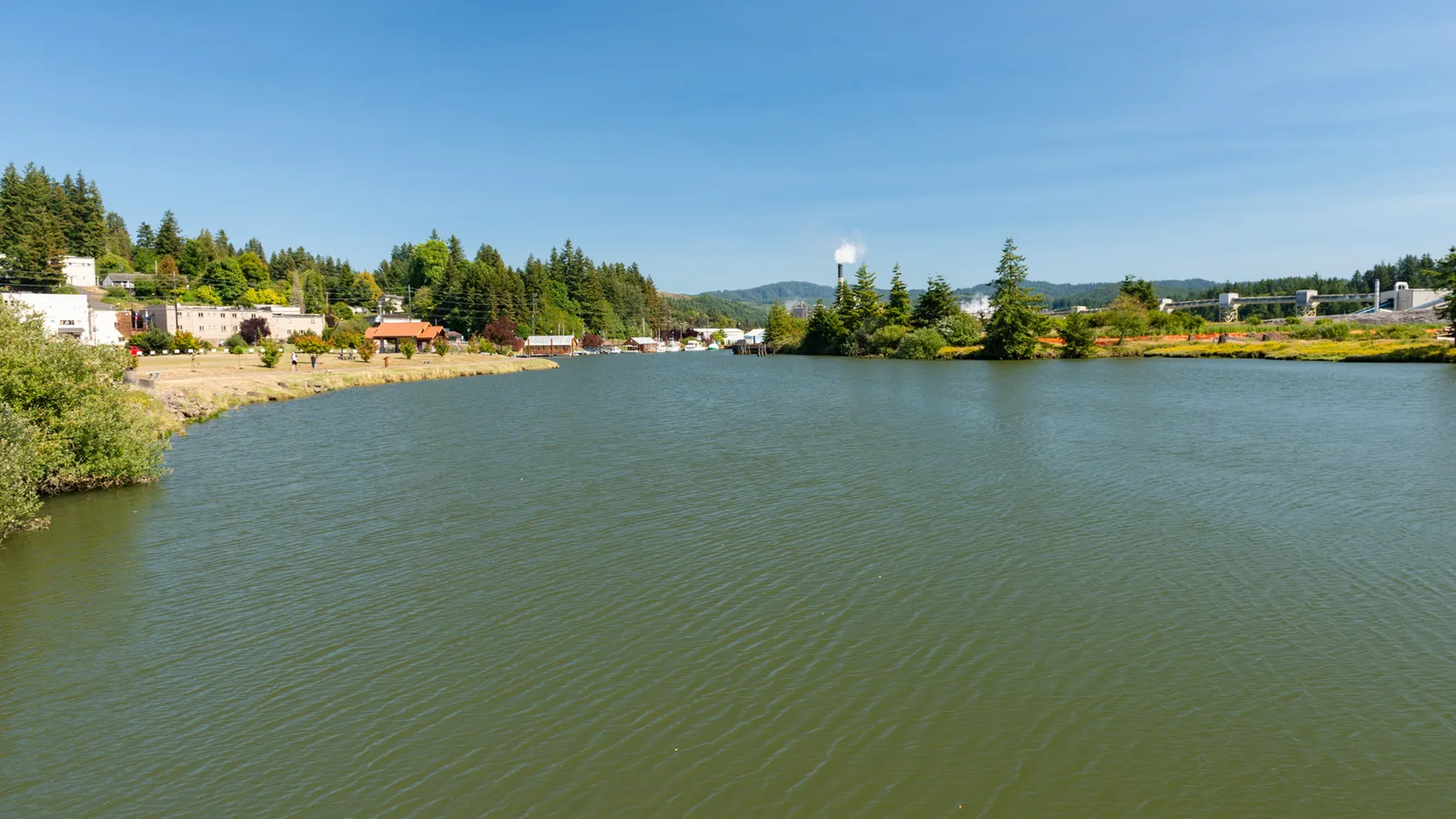
Drive up the Yaquina River from Newport and Toledo’s skyline is easy to pick out. Stacks and steam from the Georgia-Pacific mill have marked the town for nearly 70 years. In a county known for beaches, fishing and tourism, the mill is the biggest industrial operation and one of the largest private employers.
A century of mill work
The site’s industrial history began before Georgia-Pacific. During World War I, the federal government built a large spruce mill in Toledo to cut lumber for military aircraft, according to the Toledo history site toledooregonhistory.com. The war ended before it reached full production. The property was bought by C.D. Johnson and partners, and by the 1920s the C.D. Johnson Lumber Company was one of Toledo’s largest employers.
Georgia-Pacific acquired the Johnson operation in the early 1950s and built a kraft pulp and linerboard mill, which began running in 1957 and had its grand opening in March 1958. The mill was Georgia-Pacific’s first move into pulp and paper. The old sawmill, built to cut huge old-growth logs, closed in 1962 as those logs became scarce. Georgia-Pacific has been owned by Koch Industries since 2005.
What it makes
The Toledo mill does not make boxes, paper towels or toilet paper. At a Newport chamber lunch in 2026, Georgia-Pacific’s Andrea Formo explained that it makes linerboard and corrugating medium, the two paper layers that are glued and fluted together to form corrugated cardboard, Oregon Coast Breaking News reported. Large rolls are cut to order and shipped mainly to box plants, many of them in California, that make boxes for farms, e-commerce and other industries.
The mill is integrated, meaning it makes pulp on site. Wood chips are cooked in digesters with a chemical solution called white liquor. The spent “black liquor” is burned in recovery boilers to make steam and power, and the chemicals are recovered and reused. The mill also takes bales of used cardboard, removes plastic, wire and other debris, and recycles the fiber. Formo said cardboard fiber can be recycled about seven times.
An economic anchor
Formo said the mill has more than 450 employees, many of them second- or third-generation mill workers. According to an economic analysis the company commissioned, the mill generated about $117 million to $118 million in labor income in Lincoln County in 2025, roughly 9% of all income earned in the county. The company said that, counting indirect effects, the mill supports about 1,560 jobs in the county and adds about $275 million to local GDP. These are the company’s own estimates.
The mill’s annual maintenance shutdown in March brings in about 1,800 contractors, Formo said. They fill hotels and restaurants during one of the coast’s slowest months.
Mill jobs have historically paid above the county average, which matters in a county where many jobs are seasonal and pay less. The mill also buys wood chips, trucking, maintenance and other services from businesses across the region.
Challenges
Like other Northwest paper mills, Toledo has gone through ownership changes, upgrades and layoffs over the decades. Mill employment was close to 1,000 in the late 1960s, according to a Port of Toledo history, far above today’s level. Demand for containerboard rises and falls with the economy and online shopping.
Formo described two current problems. The first is hiring skilled trades such as pipefitters and millwrights. The company is working with local high schools and Oregon Coast Community College to train workers. The second is housing. She said it is hard to persuade recruits from other states to move to a high-cost coastal housing market, which we have covered in our story on the housing squeeze.
She also called Oregon’s regulatory climate “quite challenging” for manufacturers, though she said the company supports regulation. Oregon DEQ regulates the mill’s air emissions and wastewater discharge.
Toledo’s identity
Toledo calls itself a working town, and the mill is a big reason. Along with the Port of Toledo boatyard, it keeps industrial jobs on the Yaquina River in a county that has otherwise shifted toward tourism and services. The smell of the mill is part of life in town, and many residents have a parent or grandparent who worked there.
Marnie Holcomb is the editor and publisher of Oregon Coast Daily News and covers Lincoln County government and community life.