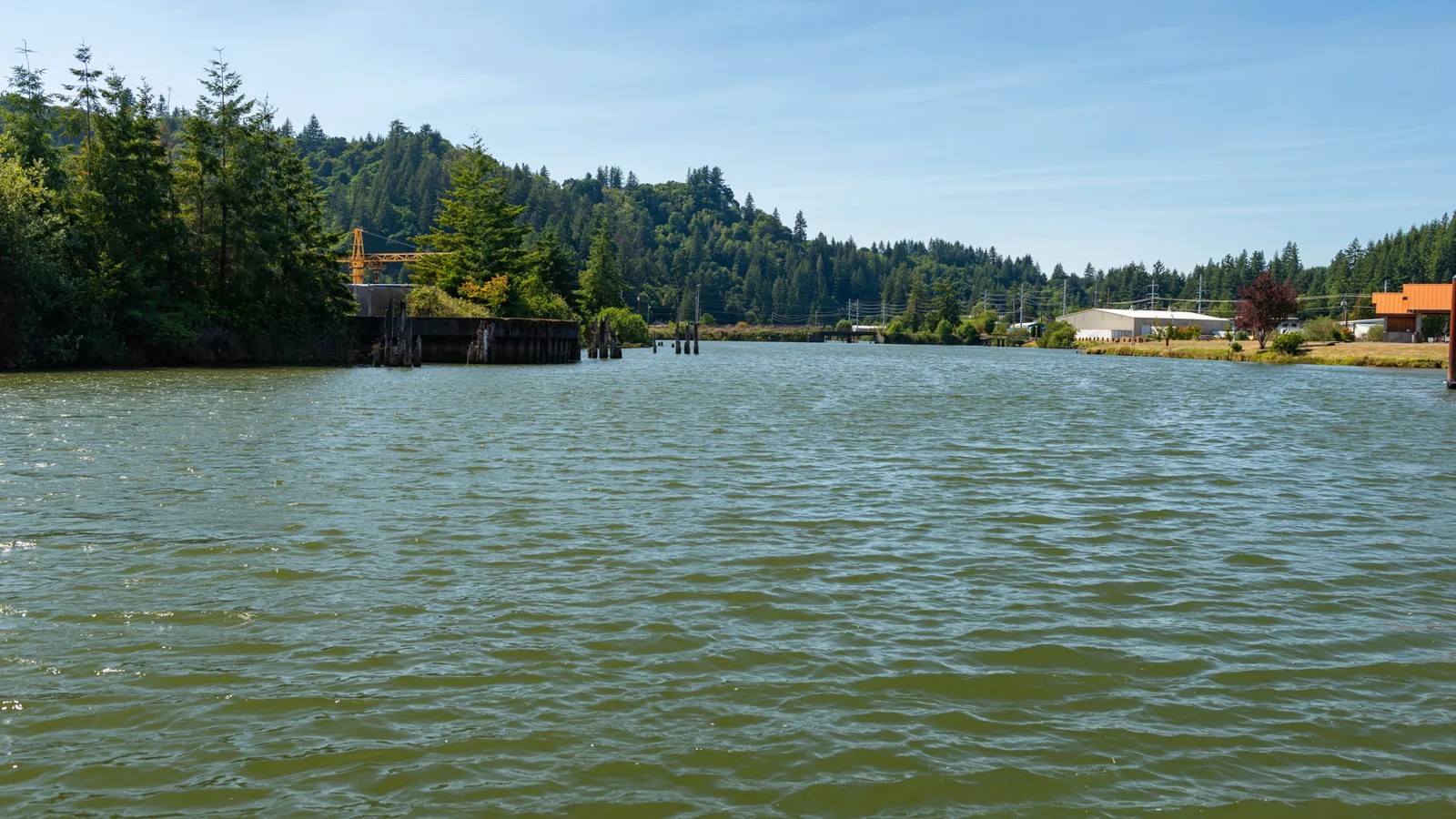
Photo: Gary Halvorson, Oregon State Archives / Wikimedia Commons, CC BY 4.0
Up the Yaquina River from Newport, the Port of Toledo runs a shipyard that serves fishing boats from far beyond Lincoln County. Boats from as far south as San Diego and as far north as Southeast Alaska have come to Toledo for repairs, according to the port. It is one of the few yards on the Oregon coast that can haul out large commercial vessels.
How the port got into the boatyard business
Toledo’s riverfront has a long history of mill and marine work. The yard now owned by the port was operated by boatbuilder Fred Wahl’s company until the port bought it at the end of December 2010, with a loan from the Oregon Business Development Department. The port reopened the yard in February 2011, announcing on its blog that it was “in the boatyard business.” The port’s goal was to keep repair work, and the jobs that come with it, on the central coast.
The port’s strategic business plans set out a path for growth, and the port has said it followed them closely. Former port manager Bud Shoemake said in a port news release, “Everything we’ve done is because of the plan.” He also said the plan helped attract state investment.
The big lift and the big building
The largest upgrade was a 660-ton mobile boat lift, which can pick up large fishing vessels and move them around the yard. It was funded in part with a Connect Oregon grant from the Oregon Department of Transportation. The port also uses a smaller 85-ton lift for smaller boats.
The port later added a $5.1 million, 90-foot-tall work building, also funded partly by Connect Oregon and built by JH Kelly. It was designed to fit the big lift so crews can bring boats inside for sandblasting, painting and welding with environmental controls and protection from the coastal rain.
A busy yard
The port says the yard has been busy since it opened. In one month during the 2020 pandemic, the port reported working on 12 large fishing vessels using the big lift, from the 60-foot F/V Timmy Boy to the 111-foot F/V Hickory Wind, along with 15 smaller vessels on the 85-ton lift, including Oregon State University’s 54-foot research vessel Elakha. The yard was considered an essential business under the state’s stay-home order. Work was booked months ahead.
Why a yard matters
Commercial fishing boats need regular haul-outs for hull work, painting, propeller and shaft repairs, engine work and inspections. Without a yard nearby, owners would have to take boats to Washington, California or farther, losing time and money. “This is an important facility, not only for this community but for the Newport and Depoe Bay fishing fleet, as well as supporting the regional fishing fleet,” Shoemake said. He added that without it, the central coast economy would lose millions of dollars in economic activity every year.
The yard also supports skilled jobs. Welders, mechanics, electricians, painters and other trades work there, both for the port and for private marine businesses using the yard. Those are year-round jobs in a county where many are seasonal.
Oregon Coast Community College runs its welding lab at the Port of Toledo, which links the yard to training for the next generation of trades workers. We covered that in our story on the college.
For Toledo, a mill town that has seen much of its old industry leave, the shipyard is a reminder that its waterfront can still support skilled industrial work.
Silas Kerrigan covers business, the tourism economy and household finance in Lincoln County.