Photo: Rick Obst / Wikimedia Commons, CC BY 4.0
Planning for a Cascadia earthquake on the central coast comes down to a few things you can do now, while nothing is happening. Emergency managers in Lincoln County and the Oregon Department of Emergency Management give the same core advice, and it is short enough to remember.
The reason is simple. The Cascadia Subduction Zone, 70 to 100 miles offshore, has produced 43 earthquakes in the last 10,000 years, according to the state. The last, on Jan. 26, 1700, was an estimated magnitude 9.0 and sent a tsunami across the Pacific to Japan.
When the shaking starts
Drop, cover and hold on until the shaking stops. A great Cascadia earthquake could shake for several minutes. If you are on the beach or in the low-lying parts of town when it ends, move inland or uphill on foot right away. Do not wait for a siren or a phone alert, and do not go back for belongings. Stay on high ground until officials say it is safe, because a tsunami arrives as a series of waves over many hours, and the first is not always the largest.
If you get a ShakeAlert warning on your phone before the shaking reaches you, use those seconds to take cover. On the coast, a strong earthquake is itself the tsunami warning.
Plan the walk
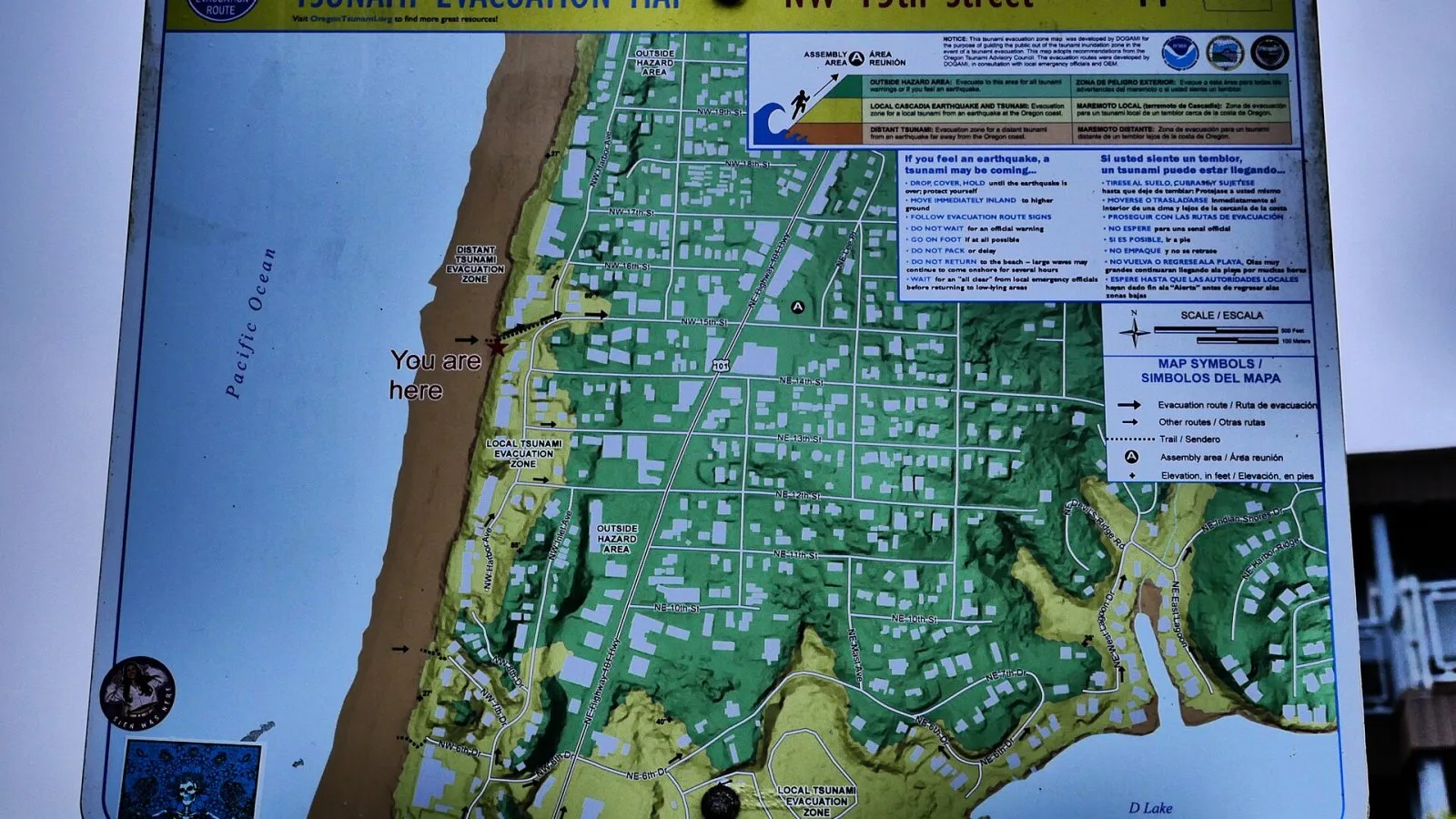
Look up your home and workplace on the state’s tsunami evacuation maps and find the nearest high ground outside the local hazard zone. Then walk it. Note the time, and look for things that could block the way after an earthquake, such as power lines, a bridge or a steep bank. Families should agree on a meeting place outside the zone, since children at school will evacuate with staff. Our guide to tsunami evacuation maps explains the two hazard zones and where to find maps for each town.
Plan for people who need help. Older relatives, neighbors with disabilities and young children may need more time or assistance. Talk with neighbors about who might need help getting out.
Pack for two weeks
The state’s “Be 2 Weeks Ready” campaign asks Oregonians to be able to look after themselves for two weeks, because roads, bridges and power lines to the coast could be out for a long time. A household kit should include water, at least a gallon per person per day, or 14 gallons per person for two weeks. Add food that keeps, medications, a flashlight, a battery or crank radio, warm layers, sturdy shoes, a first aid kit and copies of important papers. Remember pets.
Storing that much water takes space, so many households use a mix of commercial water containers, rain barrels and water filters. Rotate stored food and water over time. Keep a smaller grab-and-go bag by the door or in the car, with water, snacks, a flashlight and a warm layer, since you may need to leave on foot quickly.
After the quake
Expect aftershocks, some strong. Once you reach high ground, stay there. Communications may be limited, so a battery radio may be the best source of news. Text messages often get through when calls don’t. Check on neighbors if it’s safe.
Know the other warning
A tsunami from a distant earthquake would come with hours of warning, and local officials would use sirens, alerts and door-to-door notices. Sign up for Lincoln Alerts, the county’s emergency notification system, which lets you add home, work and school addresses and choose to get messages by text, email, phone or app. Each household member can have a profile.
Keep phone emergency alerts switched on. Our article on ShakeAlert earthquake warnings explains what a phone alert can and cannot do, and our report on Cascadia research covers the science behind the risk.
Rosalind Teague covers ocean science, coastal hazards and the people who shaped the central coast.