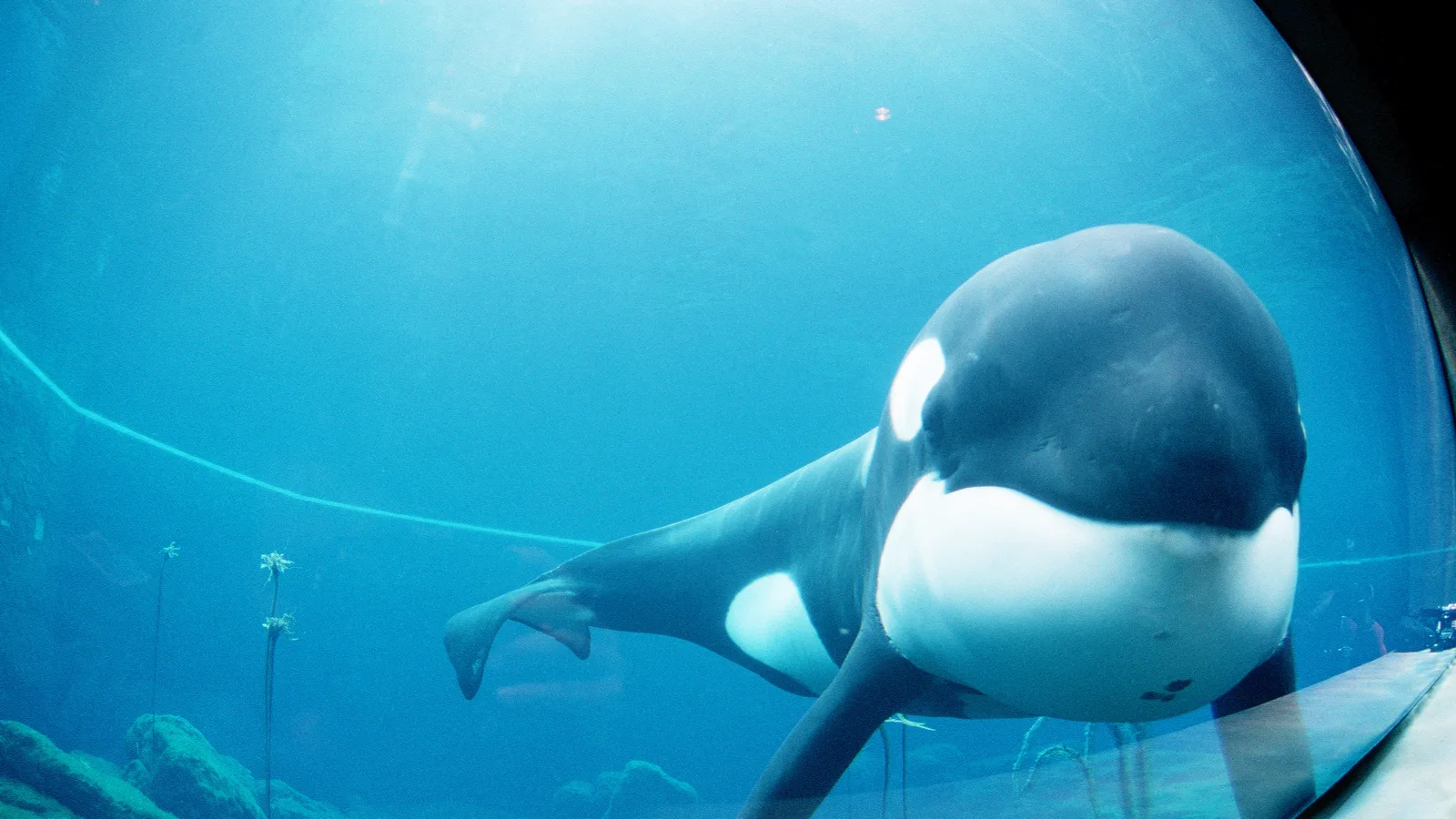
Photo: Author unknown / Wikimedia Commons, Public domain
On Jan. 7, 1996, a UPS cargo plane landed in Newport carrying a 21-foot killer whale in a custom tank. Keiko, the orca from the movie “Free Willy,” was trucked to the Oregon Coast Aquarium in South Beach and lowered into a new pool built for him. For the next two and a half years he was the most famous resident of Lincoln County.
How he got here
Keiko was captured as a young orca off Iceland in 1979, according to the Oregon Encyclopedia. He was kept there for three years, then sold to Marineland in Ontario, where he began performing. In 1985 he was sold to Reino Aventura, an amusement park in Mexico City. The pool was too small and too warm, and the chlorinated water worsened skin lesions. His dorsal fin had already begun to droop. Observers believed he would likely die within a few years.
Then came “Free Willy,” released by Warner Bros. in 1993, about a boy who frees a captive orca. The film was a hit, and audiences learned that the real whale was in poor shape in Mexico. In 1995 Warner Bros. and Northwest cellular entrepreneur Craig McCaw set up the Free Willy Keiko Foundation, and donations, many of them from children, paid for a rehabilitation facility in Newport. The foundation built a pool holding about 2 million gallons of cold, natural seawater, at a reported cost of $7.3 million, according to the Earth Island Institute. The U.S. Air Force and UPS helped with the move.
Life in South Beach
Keiko did well in Newport. He gained weight, his skin improved, and caretakers worked on building his strength and teaching him to catch live fish. CNN reported a year after his arrival that he was noticeably healthier.
He was also a phenomenon. The aquarium’s attendance more than doubled, reaching about 1.3 million visitors in 1996, Earth Island reported. People lined up to look through underwater windows at the whale, and Newport’s motels, restaurants and shops felt the effect well into the off-season. Keiko merchandise was everywhere.
That success created a dilemma. The whole point of bringing Keiko to Oregon was to prepare him for release, and his stay was always meant to be temporary. Many marine biologists doubted that an orca who had depended on people since he was a juvenile could ever survive on his own. Disagreements between the aquarium and the foundation over his care and his readiness became public.
Leaving for Iceland
On Sept. 9, 1998, Keiko was flown from Newport to a sea pen in a sheltered bay in Vestmannaeyjar, Iceland, near where he had been captured. Jean-Michel Cousteau’s Ocean Futures Society later took over his care. His training included swims in the open ocean, escorted by boat.
The Seattle Times reported the following spring on a Newport adjusting to life without its celebrity, as aquarium attendance fell back from its Keiko peak.
On one of his open-ocean excursions in 2002, Keiko swam off and turned up about 870 miles away off the coast of Norway. There he again drew crowds, accepting fish from boaters and letting some people climb on his back. His handlers moved him to Taknes Bay, hoping he would join a wild pod. He never did. On Dec. 12, 2003, he beached himself and died of pneumonia, according to the Oregon Encyclopedia.
The Oregon Coast Aquarium held a memorial on Feb. 20, 2004, and about 700 people attended.
What he left behind
The pool built for Keiko did not sit empty. The aquarium later turned it into Passages of the Deep, its walk-through tunnel exhibit of sharks, rockfish and other Pacific species, one of the aquarium’s signature attractions.
Keiko’s larger legacy is about attitudes. His story was an early step in changing public opinion in the United States about keeping orcas in captivity. It also showed how hard it is to return a long-captive orca to the wild, even with years of work and money behind the effort. The aquarium never brought in another orca. For many people in Newport, he is still remembered as one of their own, and for the town, his stay was a reminder of how much a single attraction could change the local economy. For more on that side of the story, see our look at the aquarium as a South Beach economic anchor.
Dewey Albrecht covers the Port of Newport, commercial and sport fishing and the Yaquina Bay bar.