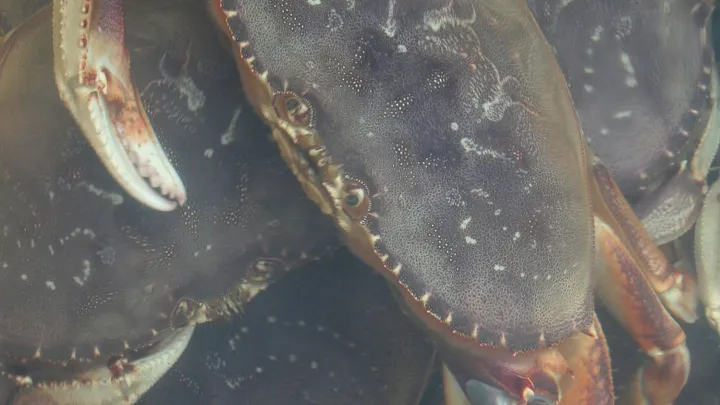
Dungeness crab caught off Newport are, genetically, part of the same population as crab off California and Washington, according to an Oregon State University study based at the Hatfield Marine Science Center.
The researchers found strong genetic diversity across their sampling sites and little genetic “differentiation” between them. That means there likely are not separate sub-populations along the coast that would call for different management, OSU said in its announcement of the study. Oregon Sea Grant, which funded the work, summed it up as no need to alter Dungeness crab management based on the genetic data.
For a fleet whose biggest payday comes from crab, that matters. Dungeness is the Northwest’s most valuable commercial seafood product, OSU noted, yet little was known about its population structure.
What the researchers did
The team sampled crab at 33 sites along about 1,200 kilometers of coast in 2012 and went back in 2014, analyzing more than 3,000 crab. The results were published in the journal Molecular Ecology. The Sea Grant award went to Kathleen O’Malley, Oregon’s state fisheries geneticist at OSU, and the study was led by Tyler Jackson as a master’s student in OSU’s Department of Fisheries and Wildlife.
“The lack of strong differentiation suggests that our Dungeness crab along the West Coast are part of a ‘single evolutionary population,'” Jackson said in the university’s announcement. “There is enough genetic exchange throughout the California Current System to prevent the population from diverging into multiple sub-populations.”
That doesn’t mean a crab off Washington started life off California. Jackson said minor genetic differences turned up between crab sampled far apart.
Why diversity is the insurance policy
The researchers stressed genetic diversity because the fishery takes so much of the legal catch. Up to 90% of legally available male crab are harvested each year, OSU said. “Having strong genetic diversity provides the population with a better chance of withstanding human-induced or environmentally induced stressors,” Jackson said.
O’Malley pointed to a gap the study only begins to fill. “There has never been a comprehensive stock assessment on Dungeness crab, which is surprising considering its value,” she said in the announcement. She noted it takes four years from hatching for a crab to reach harvest size, and that a follow-up study would look at genomic diversity among megalopae, the final larval stage, off Oregon.
Oregon’s commercial season is managed through rules on crab size, sex and season, plus meat-fill tests that help decide when boats can go out. Our harbor and fishing coverage follows those decisions each winter, including this year’s delayed opener and the latest meat-fill results.
The full findings are in the Molecular Ecology paper, and OSU’s announcement lists O’Malley and Jackson as contacts for anyone who wants the details.