Photo: Anonymous-232 / Wikimedia Commons, CC BY-SA 4.0
Depoe Bay is one of the few towns on the Oregon coast named for a Native person who actually lived on the land it occupies. The name comes from Charles “Charley” DePoe, a Tututni man from the Rogue River country who was removed to the Coast Reservation in the 1850s and became one of the respected figures of the Siletz community.
“Depot Charlie”
In 1855 the U.S. Army set up a supply station on a slough off the Yaquina River, about a mile from where Highways 20 and 229 now meet near Toledo, according to the City of Depoe Bay’s history pages. Supplies for the Siletz Indian Agency arrived there by ship and were carried overland to the agency. The waterway is still called Depot Slough.
Charley’s connection to that depot is the likely source of the name he was known by, “Depot Charlie,” which settled over time into DePoe. Agency records show the name in use by the 1870s. Minutes of a council held at the Siletz Agency on Dec. 15, 1873, record a speech by “Depot Charlie,” identified as a Joshua man “one of the most influential Indians on the reservation.” In it, as the city’s transcription shows, he asked federal officials for a sawmill to build a church, a flour mill so families could grow and sell their own wheat, and wagons so that older women would not have to carry firewood on their backs.
He was later called Chief. Jodi Weeber, a former archivist at the Lincoln County Historical Society, has said the title was earned rather than inherited, according to the city. When he died, the Lincoln County Leader wrote on July 12, 1918, that he had been noted for “good sense and wise councils and hospitality,” and that no one ever left his home hungry.
The allotments
The 1885 reservation census lists Charley, then about 50, and his wife, Minerva, called Minnie, about 48, with five children: William, Delia, Robert, Clara and Matilda. In 1894, as the federal government broke up much of the Coast Reservation and opened it to outside settlement, tribal members received land allotments. Charley and Minerva each received 40 acres north of the present town, according to allotment maps held by the historical society.
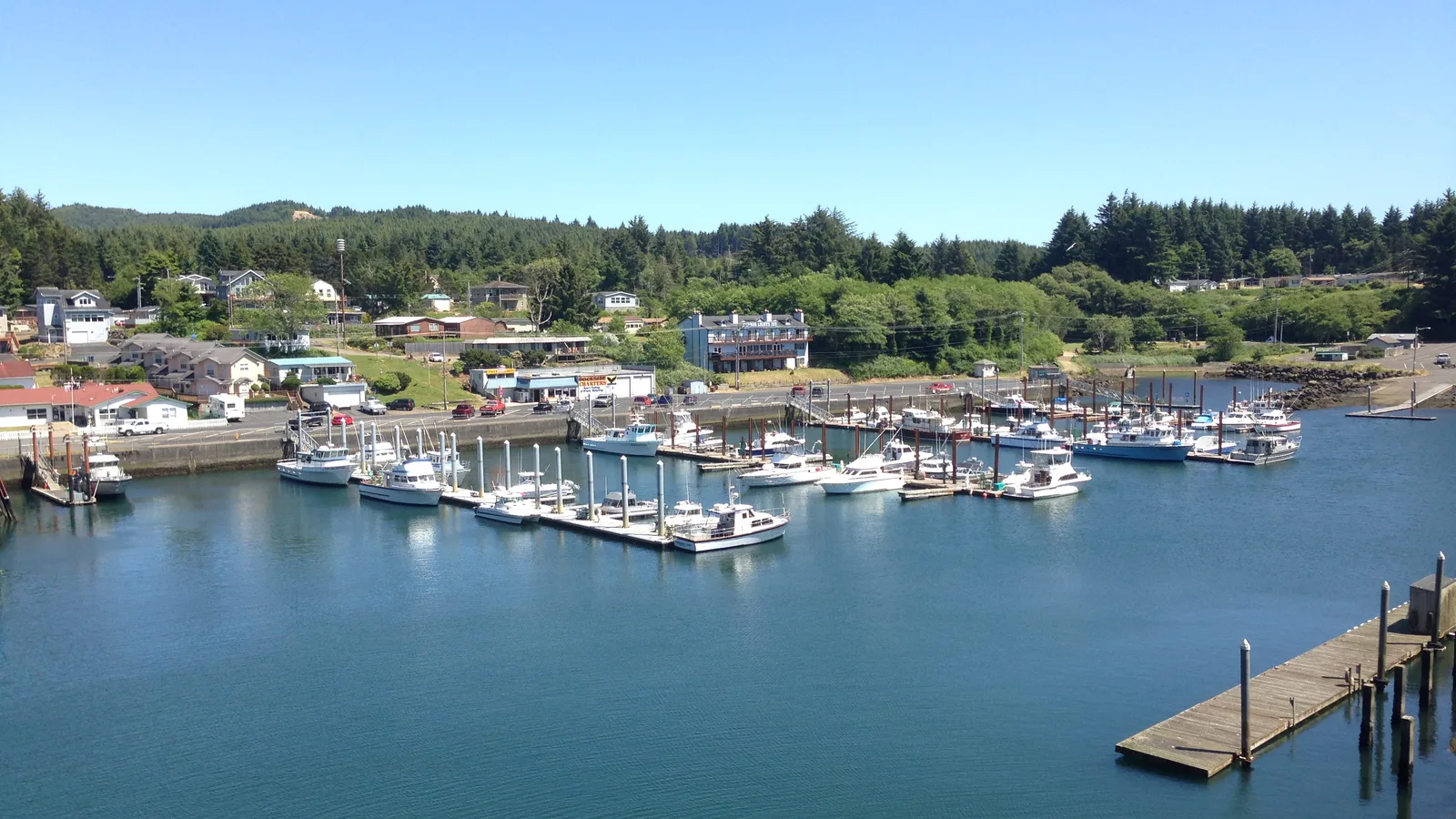
Altogether, more than 200 acres beside “a small ocean bay” went to Charley and his heirs. A plat from around 1915 shows Charley, Minnie, Matilda and William owning all of the oceanfront from the north side of what is now Boiler Bay south to the area called South Point. Matilda’s allotment ran from the small peninsula to the middle of the harbor, and William’s from the bay to what is now Southpoint Street.
How the land left the family
That ownership did not last. Like many Siletz families in that period, the DePoes lost land through sales at low prices and tax forfeitures. After Matilda and William died, their siblings sold the property in 1923 to Frank and Rachel Carson, a Siletz couple, the city’s history says. The Carsons sold it to a speculator named Lee Williams for $6,000. In late 1926 or early 1927 Williams sold it to the Sunset Investment Company for $10,000. Sunset laid out 185 lots around the bay and sold them for $100 each, pitching the new town as a future resort. The name of the family who had owned the land stayed with it.
The family today
The DePoe line continues in the area. Charley’s great-grandson, Chief William Hauser DePoe Sr., was born in 1929, served in World War II and played professionally as a musician with bandleaders Lionel Hampton and Tommy Dorsey, according to the city. He spent his last 15 years in Depoe Bay, appearing in regalia at community events, and died in 1997. His son, Chief William “Chewescla” DePoe, holds the title, which has since become hereditary. He takes part in the tribe’s annual Run to the Rogue, a run from Siletz south to the Rogue River country the family came from, and attends the Fleet of Flowers in Depoe Bay each Memorial Day.
The town’s name is a direct link to that history. Before homesteaders arrived, coastal people speaking many different languages fished and hunted seals in the harbor. Today the Confederated Tribes of Siletz Indians, restored to federal recognition in 1977, are headquartered just up the road in Siletz.
Marnie Holcomb is the editor and publisher of Oregon Coast Daily News and covers Lincoln County government and community life.