Photo: Unattributed / Wikimedia Commons, Public domain
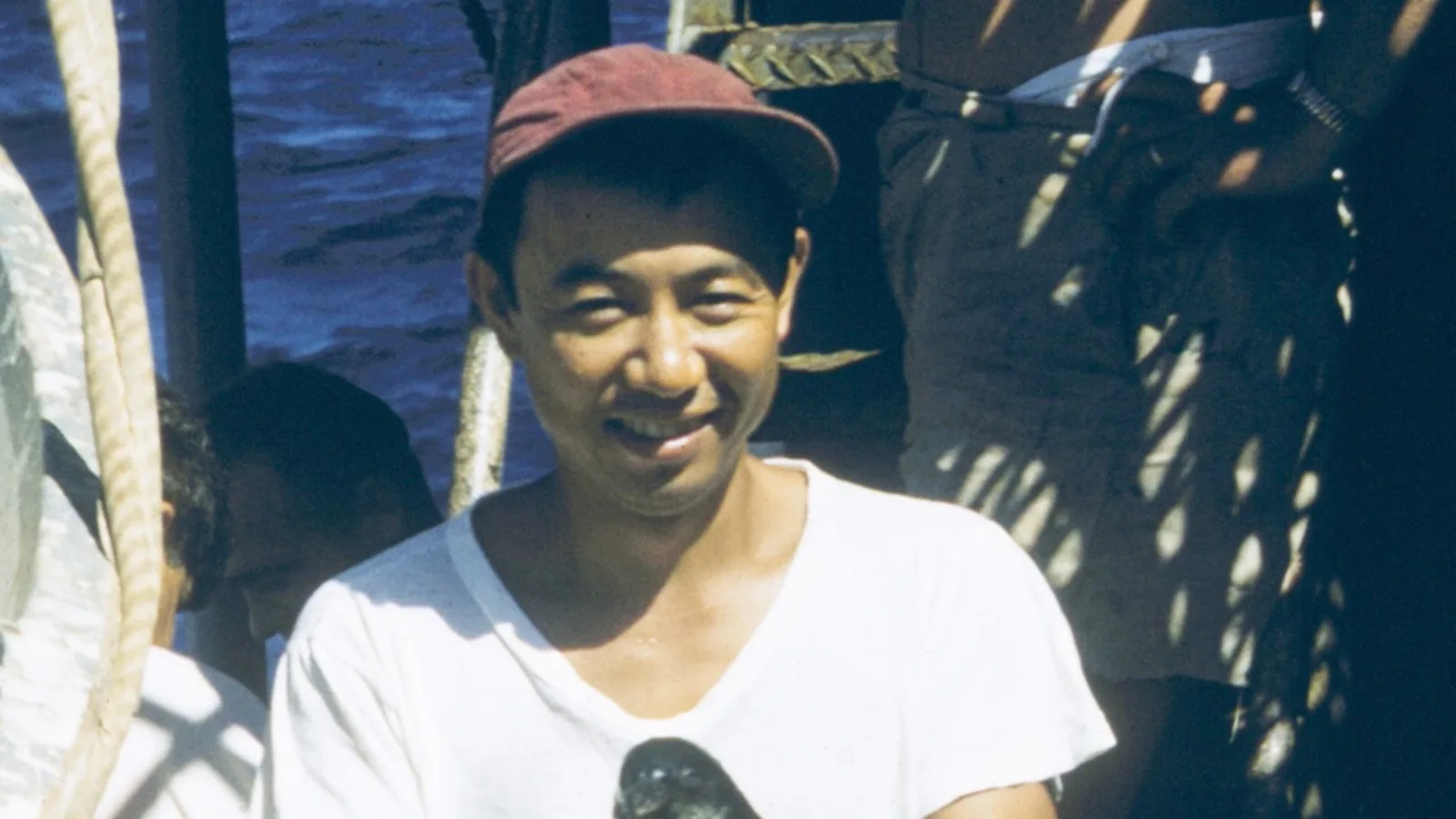
When NOAA Ship Bell M. Shimada is in port, it ties up at the agency’s Marine Operations Center-Pacific on the south side of Yaquina Bay, a white, 208-foot fisheries survey vessel that is easy to spot from the Newport bayfront. Most people who see it have no idea who it is named for. The answer is a fisheries scientist whose career lasted only about a decade, interrupted by World War II internment, and cut short by a plane crash.
From internment to the Army
Bell Masayuki Shimada was the son of Japanese immigrants and grew up in Seattle. In April 1942, according to NOAA, he was pulled out of his undergraduate studies at the University of Washington and sent to the Minidoka internment camp in Idaho, one of the camps where the federal government held Japanese Americans from the West Coast during the war.
A little over a year later he was allowed to leave the camp and enlisted in the U.S. Army. He served in Japan, was discharged in early 1946 and stayed on for several months working as a fisheries biologist before returning to Seattle to finish his degree. He went on to earn bachelor’s and master’s degrees at the University of Washington, which in 2008 also awarded him an honorary degree as part of a program for students whose studies were interrupted by incarceration.
Tuna science
In September 1948 Shimada joined the U.S. Fish and Wildlife Service’s fisheries bureau, a forerunner of NOAA Fisheries. Within months he was in Hawaii studying Pacific tuna, whose stocks were under heavy fishing pressure after the war. In February 1952 he joined the Inter-American Tropical Tuna Commission, the international body that manages tuna in the eastern Pacific. There he published work on tuna spawning, distribution and feeding and gained international recognition before he had finished his doctorate, NOAA says. He completed his Ph.D. in 1956 and was named the commission’s senior scientist.
NOAA describes him as a pioneer in approaching fisheries science from a broad ecological viewpoint, looking at fish in the context of ocean conditions and the wider food web rather than as a catch count alone. That approach is close to how much fisheries science is done today.
In 1958 he left the commission to become the first director of the Bureau of Commercial Fisheries’ new Eastern Pacific Tuna Investigations office. Shortly afterward he was killed in a plane crash near Guadalajara, Mexico, on his way to join his team for a research cruise.
Naming the ship
Half a century later, in 2007, NOAA held a contest for students in grades 6 through 12 to name its newest fisheries vessel. Five students from Marina High School in Marina, California, and their biology teacher wrote an essay nominating Shimada. It was chosen from 160 entries, according to NOAA. His son Allen also became a fisheries scientist with NOAA Fisheries.
What the ship does from Newport
Bell M. Shimada was built by Halter Marine in Moss Point, Mississippi, and commissioned on Aug. 25, 2010. It is the fourth of the Oscar Dyson-class survey ships, built to international standards for a low acoustic signature. That quiet hull matters, NOAA explains, because it lets scientists study fish and marine mammals without scaring them off.
The ship works the West Coast from Washington to Southern California, surveying fish, seabirds, marine mammals and ocean conditions. It runs acoustic surveys with a multibeam echo sounder that maps both the water column and the sea floor, and trawl surveys with a bottom net that can be towed over rough ground. It can stay at sea about 40 days with a range of 12,000 nautical miles, according to NOAA’s Office of Marine and Aviation Operations.
The data it collects feed into stock assessments for species that matter directly to Newport’s fleet, including Pacific hake, or whiting, and groundfish. When regulators set catch limits that determine how much fish crosses the docks on the bayfront, surveys from ships like this one are part of the evidence.
The ship’s home, the Marine Operations Center-Pacific, has been in Newport since 2011. For more on that base, see our story on what NOAA’s Pacific fleet base brought to Newport.
Rosalind Teague covers ocean science, coastal hazards and the people who shaped the central coast.